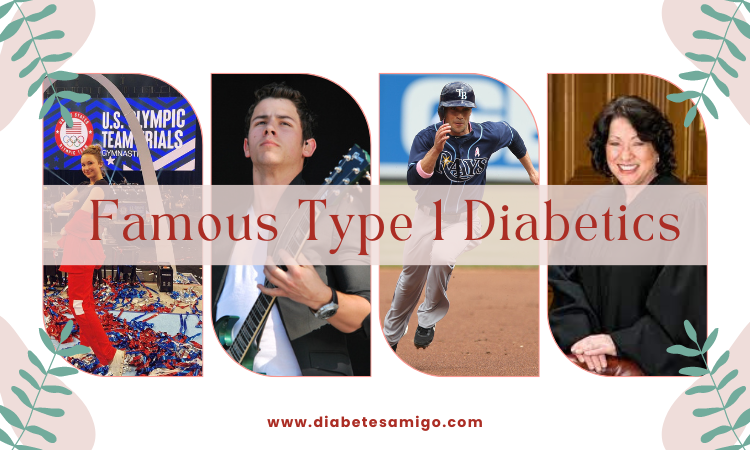
Kids growing-up with Type 1 Diabetes (T1D) need to know that they can achieve anything. Listed are individuals living with T1D that have achieved amazing accomplishments and/or fame.
This page exists for a specific moment: the one where a kid decides Type 1 is going to stop them from doing something. Ours has had that moment more than once, usually about sports. The useful answer is rarely a pep talk. It is a name, a sport, and a fact.
Key takeaway: people with Type 1 have won Olympic gold, sat on the Supreme Court, quarterbacked in the NFL, and headlined arenas. Several were diagnosed as children; several were diagnosed mid-career and kept going.
Insulin Famous / Athletes / Public Life / Famous T1Ds / Cinema with T1D / Using this with your kid
Insulin Famous
Individuals that have made a difference by using or making insulin.

Elizabeth Hughes Gossett’s story is the one that lands hardest with parents. She developed diabetes in 1918 at age eleven, when the only treatment was a near-starvation diet, and had been reduced to a skeletal weight by the time she reached Toronto in August 1922 and began receiving insulin from Dr. Banting. She lived to 73, raised three children, served as a founding trustee of Oakland University, and founded the Supreme Court Historical Society in 1972. Roughly a century separates her from a kid wearing a CGM today.
Athletes
This is usually the section that matters to a kid who has just been told they cannot do something.
- Gary Hall Jr. – American swimmer with ten Olympic medals. He was diagnosed with Type 1 in 1999 and won Olympic gold after his diagnosis, including the 50m freestyle in 2000 and again in 2004.
- Charlie Kimball – IndyCar driver diagnosed in 2007 at age 22, and the first licensed driver with diabetes to compete in the series. His father, an engineer, helped build the setup he races with: a CGM readout on the steering wheel display alongside lap time and oil pressure, and a cockpit drink system with a 3D-printed valve so he can pull water or orange juice through his helmet tube mid-race.
- Jay Cutler – NFL quarterback diagnosed in 2008 while already playing professionally, who continued a long starting career afterward.
- Chris Dudley – NBA center diagnosed at 16 who played sixteen seasons, and later founded a basketball camp for kids with Type 1.
- Kris Freeman – American cross-country skier diagnosed at 19 in 2000, and told by doctors that his competitive career was over. He went on to ski in four Winter Olympics and has spent years visiting diabetes camps.
- Scott Verplank – PGA Tour golfer diagnosed at nine, who won five tour events and played in two Ryder Cups. He wears an insulin pump on the course.
The pattern worth pointing out to a kid is not that these people are exceptional. It is that several of them were diagnosed in the middle of the thing they were already doing, and did not stop.
One name you will see on a lot of diabetes lists but not on this one: Sir Steve Redgrave, the British rower who won a fifth Olympic gold after his diagnosis. It is a genuinely great story, but he has Type 2, not Type 1 – he has said he assumed it was Type 1 himself until specialists told him otherwise years later. That is a good illustration of the caution further down this page.
Public life, music, and screen
- Sonia Sotomayor – Associate Justice of the US Supreme Court, diagnosed with Type 1 at age seven. She has written and spoken about giving herself injections as a child and has published a picture book featuring a character with diabetes.
- Nick Jonas – musician diagnosed at thirteen, and a co-founder of Beyond Type 1. He has been open about performing while managing blood sugar, which makes him one of the most recognizable faces of T1D for kids right now.
- Mary Tyler Moore – actress diagnosed as a young adult, who spent decades as a prominent diabetes research advocate and served as international chairman of JDRF.
- Bret Michaels – musician diagnosed at six, who has toured for decades with Type 1.
- Theresa May – former Prime Minister of the United Kingdom, diagnosed with Type 1 as an adult in 2012 while serving as Home Secretary.
Famous Type 1 Diabetics
Wikipedia has a comprehensive list of public figures, athletes, Olympians, actors, singers/musicians, doctors , authors, etc. with T1D. Rather than recreate the list, I have linked it here. I encourage you to add to the list if you find a person that is missing.
One caution when you go digging: plenty of celebrities are described online as diabetic without any distinction between Type 1 and Type 2, and some widely repeated claims are simply wrong. If you are going to hand a name to your kid, it is worth thirty seconds of checking – partly for accuracy, and partly because explaining the difference between the two types is a useful conversation in itself.
List of Films, Movies and TV Shows with Type 1 Diabetic Characters
Another interesting list on Wikipedia is films/TV shows that include a character with diabetes. Sometimes the filmmakers get Type 1 Diabetes symptoms, medical devices and treatment wrong but it is always nice to see T1D represented on the big screen.
Watching one of these with a kid who has T1D tends to go one of two ways. Either they feel seen, or they spend the whole scene pointing out everything the film got wrong. Both are good outcomes. Spotting bad diabetes writing is a sign your kid understands their own condition better than the screenwriter did.
Using this with your kid
A list of names is not automatically encouraging. Handled badly it turns into pressure – a kid who is having a hard week does not need to hear that someone else won a gold medal. A few things that make it land better:
- Match the name to their thing. A swimmer for a swimmer. Generic inspiration is easy to shrug off; someone doing your exact sport is not.
- Lead with the logistics, not the trophy. How Charlie Kimball gets fast sugar mid-race is more interesting to most kids than his finishing position, and it quietly makes the point that management travels with you.
- Do not use it to end a hard conversation. If your kid is upset, that comes first. Save the list for a neutral moment.
- Let them find their own. Ours has been more convinced by people they discovered than by anyone we suggested.
If you want something that does this work on a shelf rather than in a conversation, our Type 1 diabetes books post covers picture books and memoirs, and toys for T1D kids covers the version that works for younger ones.
Related on Diabetes Amigo
- Type 1 diabetes books for kids and parents
- Toys for T1D kids
- Type 1 diabetes conferences: a parent shortlist – meeting other families in person
- Newly diagnosed: what you actually need to buy