Not medical advice or a school legal plan. When your child starts helping with boluses, corrections, or device decisions is a care-team and family call. School phone and watch rules vary by district. What follows is how one household practices “trust, but verify” – not a timeline you have to copy.
There is a long stretch between “I do everything” and “they leave home.” It is not as dramatic as the college handoff we have written about before. It is quieter. Your kid can carb-count a lunch. They can press buttons on a pump. And your stomach still flips until you know the insulin actually went in.
Key takeaway: Maturity for type 1 is not one birthday. It is a pile of small jobs they can run with a parent still watching the process – meal boluses, highs, lows – using tools you already have (Dexcom Follow, pump history or remote IOB if you use Omnipod) and a simple confirm-back habit so you are not guessing from across the building.
This is not the leave-home chapter
We already have a longer post about the day Follow may stop and the dorm door closes – starting the independence handoff early. This post is earlier and smaller.
Here the question is: how do we let them practice real diabetes work while we still catch mistakes? Not “you’re on your own.” More like “you drive, I still have a foot near the brake.”
How we knew they might be ready to help
We did not pick an age off a chart. We looked for boring signs:
- They can name a low and a high in plain words, not only “I feel weird”
- They will pause a game or a conversation long enough to treat
- They can walk through a meal bolus with us – carbs, active insulin if that is part of their plan, confirm before they deliver
- They tell the truth when they forgot, even when it is embarrassing
- School (and the 504, if you have one) is ready for the tools you plan to use
If any of those are shaky, we keep more of the work on the adult side and practice in low-stakes settings – kitchen table, weekend, not a silent classroom test.
Trust, but verify – the process, not vibes
“Trust” without a check is hope. “Verify” without trust is hovering until everyone is miserable. We try to verify the steps, not micromanage every feeling.
Food boluses (if they wear a pump and that is your plan):
- They estimate carbs (or use the label) the way the care team taught
- They enter the bolus in the app or PDM – we do not invent numbers here; their ratios and settings stay clinic territory
- We confirm delivery happened – history, IOB that makes sense for what they ate, or a quick “done” from them
- If something looks off, we ask what they entered before we assume the pump failed
Highs: same idea. Did they check, did they follow the correction plan your endo gave, did insulin actually deliver, is Follow still climbing for a reason (food still digesting, site issue, missed bolus)? We are looking for process, not perfection.
Lows: treat first, talk later. Verify they have fast carbs, that they stopped what they were doing, and that they are coming back up on Follow – not that they “felt fine” and kept playing.
If your child is still on injections (MDI), the same spirit applies with pens and logs – verify the dose was given and the timing matches the plan. Not every family has a pump. That is normal.
What we watch on the parent phone
Devices only help if you already use them and school or home rules allow them. For our household that has meant two parent-side windows:
- Dexcom Follow (or your CGM’s share tool): arrows and alarms so we know when something needs a human. Follow does not prove a bolus happened. It only shows glucose.
- Omnipod / pump view when available: remote or history views that show insulin on board (IOB) and recent delivery. That is how we “see” whether a lunch bolus likely went in without marching into the cafeteria. Features and apps change – check what your pump brand actually supports for caregivers right now, and what your clinic is okay with.
Together they answer different questions. Follow: “where is glucose going?” Pump history / IOB: “did insulin show up for that meal or correction?” One without the other is half a story.
Our simple watch texts (with school approval)
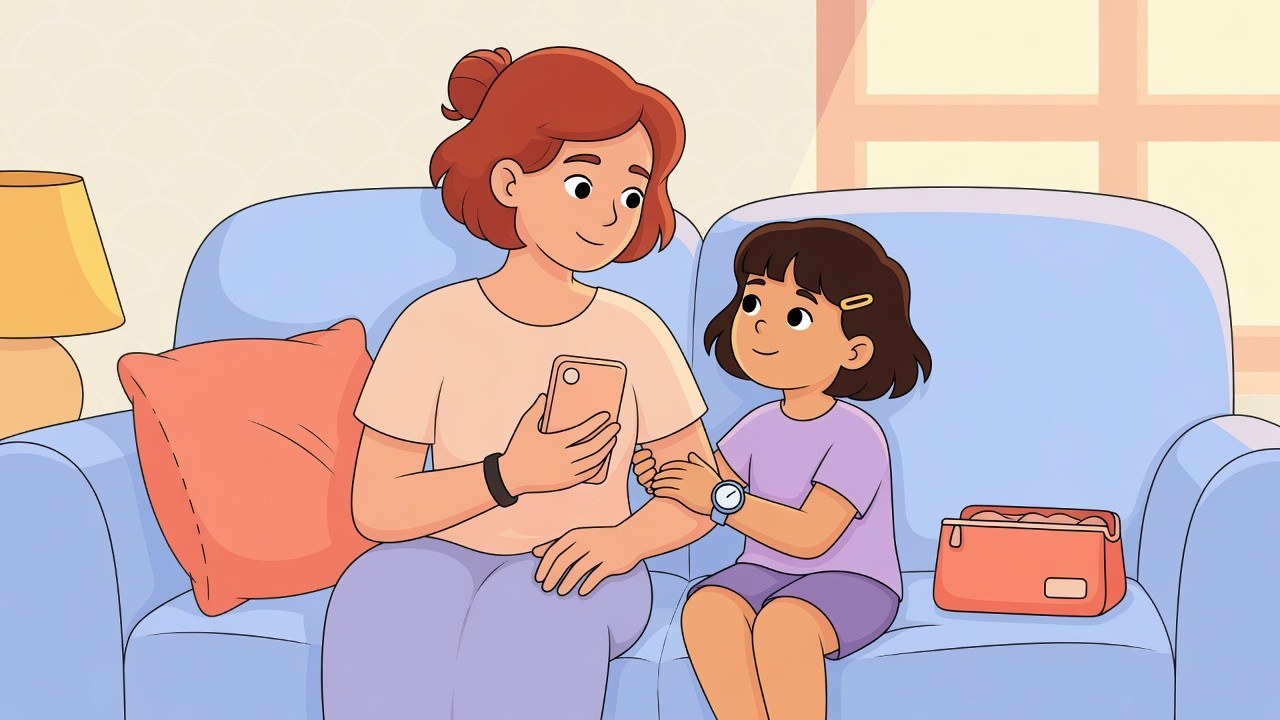
Phones in backpacks do not help mid-class. With the school’s okay, we used a basic wristwatch that could receive short parent texts. The point was not long conversations. It was a tiny loop:
- Parent sees something on Follow or suspects a missed step
- Parent sends a short command – check, treat, bolus for lunch, confirm IOB, whatever fits their written plan (we are not listing your child’s doses here)
- Child replies with a one-letter confirm so we are not guessing
Replies we actually used:
- K or Y – yes / done / got it
- N – no / not yet / need help
- Sometimes a second K after the action, so “I saw your text” is not the same as “I finished the step”
That sounds almost too simple. That is why it worked. Long paragraphs on a watch face invite ignoring. One letter is hard to misread in a hallway.
School first: put watch/text rules in the conversation with the nurse and, if you have one, the 504 plan. Some schools are fine with a medical device watch. Some are not. Do not invent a system that gets the watch confiscated on day two. Our school box post is still the place for the physical supplies list; this is only the communication layer.
How we grow trust without jumping the cliff
- Start at home – weekend meals where you can still walk over
- Then school with a short leash – they run the steps, you verify on apps + one-letter texts
- Widen when the process is boring and reliable – fewer check-ins, not zero
- Pull back without shame if honesty slips, tech fails, or life gets chaotic (growth, sports seasons, new school). Independence is not a trophy you never put down.
Sleepovers and parties are another practice field – different building, same verify habit. See sleepovers and birthday parties.
What we are not doing
- We are not handing over full overnight responsibility because they can bolus lunch
- We are not treating Follow as proof they bolused
- We are not using texts to invent dosing instructions that are not already in their care plan
- We are not shaming a “N” reply – that is the system working
- We are not assuming every kid has a pump, a watch, or a school that allows either
Overnight is still mostly our job even when daytime boluses get more shared. The sci-fi version of that worry is in Optimus overnight watch for kids with type 1 – hopeful, not a care plan.
Bottom line
Helping manage type 1 is a skill stack, not a personality test. Give them real steps. Keep a parent-side view of glucose and insulin when you have the tools. Ask for a tiny confirm so trust has evidence. Tighten or loosen as honesty and safety show you. And keep the endo in the loop when you change who does what – especially at school.
FAQ
What age should kids start bolusing on their own?
There is no universal age. Maturity, honesty, device skills, and school support matter more than a birthday. Ask your diabetes care team what they want to see before you widen responsibility.
Does Dexcom Follow show that a bolus happened?
No. Follow (and similar share apps) show glucose trends and alerts. Pump history, IOB, or your child’s confirm is what tells you insulin was delivered. Use both when you can.
Do we need a smartwatch?
No. We used a simple text-capable watch because phones were not always reachable in class and school approved it. Some families use a nurse check, a shared phone at lunch, or only home practice. The habit is “ask + confirm,” not a specific brand of watch.
What if they reply Y but nothing changed on Follow?
Stay calm and dig into process – wrong carbs, bolus not delivered, site issue, still-absorbing food, or a misunderstood text. That is exactly why verify exists. If you are worried about safety, contact the school nurse plan and your care team as you normally would for an unresolved high or low.
Not medical advice. Talk with your child’s diabetes care team before changing who boluses, who corrects, which apps share data, or what is allowed at school. For the later leave-home stage, see our independence handoff notes.